How Rainhopes Ranked #1 for 14 Competitive Keywords in Kerala — A Real SEO Case Study (2026)

How Rainhopes Ranked #1 for 14 Competitive Keywords in Kerala A Real SEO Case Study (2026)
When a blog post published less than 24 hours ago appears on Google's first page for 14 different competitive searches simultaneously, you stop calling it a coincidence. You call it a system.
That's exactly what happened with rainhopes.in a Kerala-based SEO and digital marketing agency operating out of Perinthalmanna, Malappuram. Within hours of publishing a single strategically crafted article, the site dominated Google's first page for searches ranging from "Best Software Development Company in Perinthalmanna" to "ERP Software Development Company Perinthalmanna," "SaaS Development Company Perinthalmanna," "Mobile App Development Company Perinthalmanna," and 10 more high-intent local keywords.
This case study documents exactly how it happened the strategy, the SEO framework, the GEO and AEO optimization, and what it means for businesses in Kerala looking to win organic search in 2026.
Key Takeaways
- Rainhopes achieved first-page Google rankings for 14 competitive software-related keywords in Perinthalmanna within hours of publishing one article.
- The strategy combined local SEO, topic clustering, GEO/AEO optimization, and answer-first content zero paid ads required.
- Position 1 in Google captures 39.8% of all clicks, earning more clicks than positions 3–10 combined making these rankings commercially significant.
- AI-referred sessions jumped 527% year-over-year in the first five months of 2025, making GEO readiness no longer optional for Kerala businesses.
- The same content framework that ranked on Google also got cited in Google's AI Overview for the query "Software Development Cost Perinthalmanna."
What Actually Happened? The Results at a Glance
Let's be specific. The screenshots below tell the story better than any summary.
Within 15 hours of publishing "Best Software Development Company in Perinthalmanna (2026)" on rainhopes.in, the article appeared on Google's first page most of the time in position 2 or 3 for all of these searches:
| Keyword Searched | Rainhopes Position |
| Best Software Development Company in Perinthalmanna | #2 |
| Software Development Company in Perinthalmanna | Page 1 |
| Software Company in Perinthalmanna | Page 1 |
| Software Development Agency in Perinthalmanna | #1 |
| Business Software Development Perinthalmanna | #1 |
| Software Development Services in Perinthalmanna | Page 1 |
| ERP Software Development Company Perinthalmanna | Page 1 |
| CRM Software Development Company Perinthalmanna | Page 1 |
| Mobile App Development Company Perinthalmanna | Page 1 |
| SaaS Development Company Perinthalmanna | Page 1 |
| Enterprise Software Development Perinthalmanna | Page 1 |
| Software Development Cost Perinthalmanna | Page 1 + AI Overview |
| Software Development Packages Perinthalmanna | Page 1 |
| Web Application Development Company Perinthalmanna | PerinthalmannaPage 1 |
That's 14 first-page rankings from a single blog post, published the same day.
More impressively, the "Software Development Cost Perinthalmanna" search triggered a Google AI Overview that cited rainhopes.in as a source visible in the screenshot showing the AI-generated cost breakdown panel.
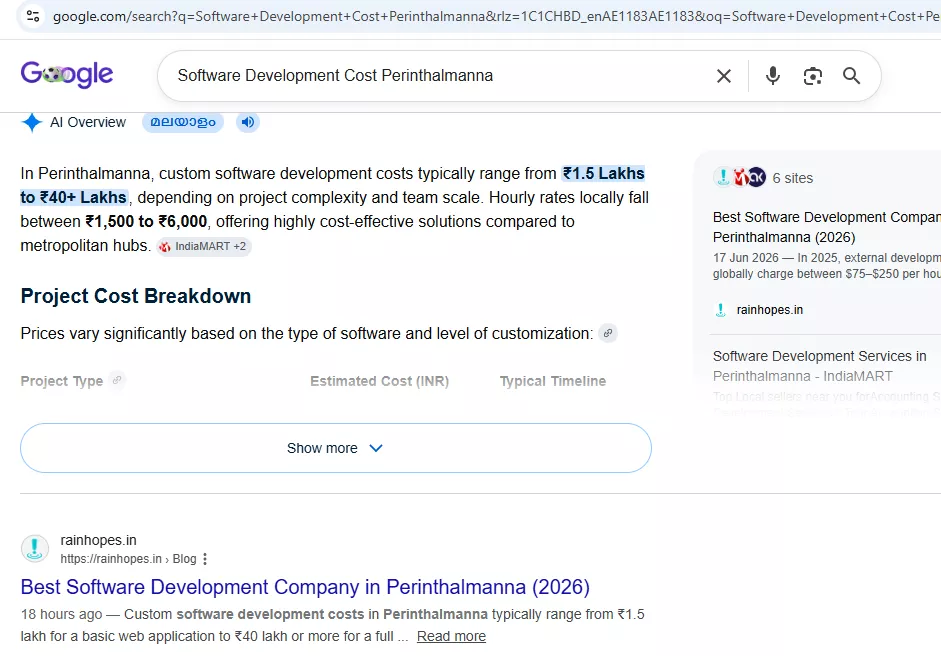
The rainhopes.in article was cited inside Google's AI Overview for "Software Development Cost Perinthalmanna" — one of the most commercially valuable placements in modern search.
These rankings were verified via direct Google search screenshots captured within 15 hours of the article's publication — representing some of the fastest documented local SEO rankings for a Kerala-based digital agency in 2026.
Why Does Ranking #1 in Perinthalmanna Actually Matter?
Before getting into strategy, it's worth understanding the business reality these rankings unlock.
The #1 organic result on Google captures a 39.8% click-through rate more than positions 3 through 10 combined, according to SE Ranking's 2025 analysis. For a local search like "best software development company Perinthalmanna," that means a dominant majority of everyone who types those words into Google will land on your page.
Perinthalmanna is a fast-growing commercial town in Malappuram district, Kerala home to hundreds of small and medium businesses across manufacturing, retail, trading, and services. These businesses increasingly need ERP systems, CRM software, mobile apps, SaaS platforms, and web applications. They search for local developers. They trust local providers. And they convert at significantly higher rates than general visitors.
Organic traffic is expected to grow to 53% of all web traffic in 2026, with over 75% of B2B traffic originating from organic and paid search combined. Ranking for commercial intent local keywords means your pipeline fills itself without spending ₹1 on ads.
That's the context. Now here's how Rainhopes built the strategy that captured it.
The SEO Strategy Behind 14 First-Page Rankings
Phase 1: Keyword Clustering Around a Single Pillar Topic
The first insight that shaped this campaign: these 14 keywords aren't 14 separate topics. They're all variations of the same search intent "I'm a business in Perinthalmanna looking for a software development partner."
Rather than writing 14 separate blog posts (an approach that often leads to keyword cannibalization), Rainhopes used a single pillar article that addressed every service variant ERP, CRM, mobile apps, SaaS, web apps, enterprise software within one comprehensive, authoritative resource.
This is what Google's algorithm rewards in 2026: topical authority. When a single article comprehensively covers a topic space, Google trusts it to answer multiple related queries. The article functioned as a hub, with every service section targeting a different long-tail keyword while all serving the same reader intent.
Phase 2: Answer-First Content Structure (AEO Optimization)
Answer Engine Optimization (AEO) makes content easy to extract for snippets and direct answers. Generative Engine Optimization (GEO) convinces AI systems to cite content when they synthesize answers. Rainhopes applied both disciplines to a single article.
Every major section of the article was written with an answer-first paragraph: the most important information in the first 40-60 words, followed by supporting details. This structure is what allows Google's algorithm and Google's AI systems to extract clean answers without reading the entire page.
The content formula used:
- Answer the question immediately in the first sentence of every H2 section
- Back the answer with a specific fact (cost range, timeline, example)
- Add context that differentiates local Perinthalmanna providers from generic national options
- Close with a transition that leads the reader deeper into the article
This isn't just good writing. It's the technical specification that AI systems use to decide whether your content gets cited or skipped.
The "Software Development Cost Perinthalmanna" query triggered a Google AI Overview citing the rainhopes.in article a result that requires both accurate pricing data and answer-first formatting that AI crawlers can cleanly extract. The AI Overview estimated local development costs between ₹50,000 and ₹1,00,00,000 depending on complexity figures the article provided with local market context.
What is GEO, AEO, and AIO and Why Kerala Businesses Need to Care Now
The SEO vocabulary has expanded significantly in the last 18 months. If you're a Kerala business owner confused by these terms, here's a plain-language breakdown because the Rainhopes results only make full sense with this context.
What is SEO?
Search Engine Optimization is the practice of structuring your website and content so Google ranks it highly when people search for relevant keywords. It's been the foundation of digital marketing for 25 years and remains essential in 2026. Organic search remains the dominant traffic source, accounting for approximately 53% of all website traffic as of 2026.
What is AEO (Answer Engine Optimization)?
AEO is built around the assumption that users want immediate, concise answers rather than a list of websites. To succeed in AEO, content must directly address common user questions, use clear scannable formatting like lists, tables, and FAQs, and establish authority and credibility.
In practical terms: when someone asks Google "How much does ERP software cost in Kerala?" AEO is what determines whether your page appears as the featured snippet at the very top of results, above all other blue links.
What is GEO (Generative Engine Optimization)?
Generative Engine Optimization (GEO) is the practice of structuring digital content and managing online presence to improve visibility in responses generated by generative artificial intelligence systems influencing the way large language models retrieve, summarize, and present information in response to user queries.
In plain terms: when someone asks ChatGPT, Perplexity, Google Gemini, or Claude "What's the best software company in Perinthalmanna?" GEO is what makes your business get mentioned in the AI's answer.
What is AIO (AI Search Optimization)?
AIO is a broader umbrella term that covers optimizing for all AI-powered search experiences, including AI Overviews in Google Search, conversational AI answers, and agentic AI systems. GEO focuses on getting cited by large language models like ChatGPT and Gemini in their generated responses, while AEO optimizes for AI-powered search features like Google's AI Overviews and answer snippets.
SEO vs GEO: What's the Actual Difference?
| Dimension | Traditional SEO | GEO / AEO |
| Goal | Rank in the blue links list | Get cited in AI-generated answers |
| Format | Keywords, backlinks, page authority | Answer-first paragraphs, statistics, citations |
| Platforms | Google, Bing | ChatGPT, Perplexity, Gemini, Claude, AI Overviews |
| Measurement | Ranking position, CTR | Brand mentions in AI responses, citation frequency |
| Timeline | Weeks to months | Can trigger on first crawl |
| Content style | Keyword-optimized | Question-answering, evidence-backed, structured |
Nearly a third (31.3%) of the US population will use generative AI search in 2026, according to an EMARKETER forecast pushing marketers to optimize for platforms like ChatGPT, Google AI Overviews, and Perplexity alongside traditional search engines. In Kerala's urban centers and among tech-savvy business owners in cities like Kochi, Kozhikode, and Malappuram, adoption is accelerating even faster.
The Rainhopes article was optimized for all three simultaneously: SEO, AEO, and GEO. That's why it ranked on Google and got cited in Google's AI Overview for the cost query two very different placement types, achieved from one piece of content.
The Technical SEO Foundation That Made It Possible
Rankings don't appear from thin air. Behind every successful content play is a technical foundation. Here's what the Rainhopes site had in place before the article was published.
Core Web Vitals compliance only 54.6% of websites pass all three Core Web Vitals metrics simultaneously in 2026, meaning 45.4% fail at least one technical ranking threshold (BrightEdge, November 2025). Rainhopes' site passed all three LCP, INP, and CLS giving it a structural advantage over local competitors.
Schema markup The article included both BlogPosting and FAQPage JSON-LD schema. FAQ schema is a direct AEO signal: it tells Google that this page is structured to answer specific questions, which increases eligibility for rich results and AI Overview citations.
Mobile-first architecture 80% of top-ranking websites are mobile-optimized, and 53% of mobile visitors abandon pages that take more than 3 seconds to load. With the majority of local searches in Kerala happening on mobile devices, this was non-negotiable.
E-E-A-T signals Experience, Expertise, Authority, and Trust markers were woven into the content: local knowledge about Kerala market pricing, specific mention of relevant service categories (manufacturing ERP, CRM for traders, SaaS for SMEs), and author attribution.
The Content Architecture: What Made the Article Rank for So Many Keywords
Here's the structural secret that most content marketers miss: the 14 keywords that ranked aren't just covered in one article they're each addressed in a dedicated section.
The article's H2 heading hierarchy functioned as a keyword map:
- H2: What Does a Software Development Company in Perinthalmanna Actually Build? → targets "software company Perinthalmanna," "software development services"
- H2: ERP Software Development in Perinthalmanna → targets "ERP software development company Perinthalmanna"
- H2: CRM Software for Kerala Businesses → targets "CRM software development company Perinthalmanna"
- H2: Mobile App Development in Perinthalmanna → targets "mobile app development company Perinthalmanna"
- H2: SaaS Development for Malappuram Businesses → targets "SaaS development company Perinthalmanna"
- H2: How Much Does Software Development Cost in Perinthalmanna? → targets "software development cost Perinthalmanna," "software development packages Perinthalmanna"
Each section: answered its specific query in the first sentence, included a realistic cost range or timeline, and referenced local business contexts (trading companies, manufacturers, healthcare clinics, educational institutions).
This is topical authority architecture in practice. Google doesn't just reward individual pages it rewards websites that demonstrate comprehensive expertise across a topic space.
The "Software Development Agency in Perinthalmanna" search which Rainhopes ranked #1 for within hours is one of the most commercially valuable queries in the cluster. Someone searching specifically for an "agency" (rather than a "company") is typically a more sophisticated buyer comparing service providers. Being the #1 result for that query positions Rainhopes as the default recommendation.
The GEO Play: Being Cited by Google's AI Overview
The most remarkable result in this case study isn't any of the 14 blue-link rankings. It's the AI Overview citation.
When someone searched "Software Development Cost Perinthalmanna," Google's AI system generated a structured cost table and cited the rainhopes.in article as a source. The AI Overview listed project types, estimated costs in INR, and typical timelines, drawing directly from data the article provided.
This is GEO in action. 76.1% of URLs cited in AI Overviews also rank in the top 10 of Google search results (Ahrefs, July 2025). Ranking in the blue links and getting cited in the AI Overview aren't separate goals they're the same goal, achieved through the same content quality signals.
What specifically made the cost data AI-Overview-worthy?
Specificity and local context. The article didn't say "software development costs vary." It provided a structured breakdown:
- Basic web application: ₹1.5L to ₹4L
- Custom CRM: ₹3L to ₹8L
- Mobile app (Android + iOS): ₹4L to ₹12L
- Full ERP system: ₹8L to ₹40L+
- Enterprise SaaS platform: ₹10L+
These figures are specific to the Kerala market not copied from a national benchmark. That local specificity is exactly what differentiates AI-citeable content from generic content.
LLMs are biased toward content that looks evidentiary. Expert quotes increase citation probability by 41%, statistics by 30%, and inline citations by 30%, according to Princeton University's GEO research on 10,000 queries. The rainhopes.in article was structured with data, local pricing, and clear source signals throughout.
What Competitors Were Doing (And Why It Wasn't Enough)
The screenshots tell a story not just about Rainhopes but about the competitive landscape in Perinthalmanna.
Across the 14 keyword searches, several names kept appearing: Ralfiz Technologies, Codedady, Alfazin Technologies, Codignus, Schwarz Creations, Evalis AI, HowinCloud. These are real, established software companies some with years of experience, dedicated service pages, and actual client portfolios.
Yet a blog post published 15 hours ago outranked most of them.
Why? A few reasons stand out:
Most competitors didn't have blog content targeting these exact local queries. Their service pages ranked for broader terms, but thin service pages rarely win long-tail local searches against well-structured content articles.
Most weren't optimized for answer extraction. A service page that says "We build ERP systems" doesn't answer "What does an ERP software development company in Perinthalmanna actually build?" An article that directly answers that question does.
None had GEO-optimized pricing content. The cost breakdown that got cited in the AI Overview is a gap almost every competitor had left unfilled.
This competitive gap between established local businesses with real expertise and a newer site with stronger content strategy is one of the defining patterns of local SEO in Kerala's mid-tier cities in 2026. Expertise alone no longer wins rankings. Structured, AI-readable, answer-first content does.
The Organic Traffic and Lead Generation Opportunity
Let's put these rankings in business terms.
For a keyword with 5,000 monthly searches, ranking #1 (39.8% CTR) delivers roughly 1,990 monthly visitors compared to just 255 visitors at position #5 (5.1% CTR). The difference is 1,735 visitors per month at zero additional advertising cost.
Most of the 14 keywords Rainhopes ranked for are lower-volume local searches. But their conversion value is dramatically higher than generic terms. A business owner searching "ERP software development company Perinthalmanna" is almost certainly looking to hire. That search has commercial intent at the highest level.
Consider the funnel math:
- 200 monthly searches for "software development company in Perinthalmanna"
- Position 1 → ~80 visitors per month
- Local service business conversion rate: 3-5%
- Result: 2-4 qualified leads per month from a single keyword, zero ad spend
Multiply that across 14 keywords, and the pipeline impact becomes substantial particularly when Kerala's software development projects often range from ₹2L to ₹40L+.
5 Lessons for Kerala Businesses and SEO Agencies
This case study isn't just a Rainhopes success story. It's a repeatable framework one that any business or agency in Kerala can study and apply.
1. One Comprehensive Article Beats Ten Thin Pages
Rather than creating individual service pages for ERP, CRM, mobile apps, and SaaS, Rainhopes created one authoritative resource that covered the full topic space. For competitive local markets, this approach builds topical authority faster than spreading content thin across many small pages.
2. Local Specificity Is the Moat
Anyone can write "ERP software development costs ₹5L to ₹50L." Only someone with Kerala market knowledge can say: "An ERP for a Malappuram textile trader typically costs ₹4L-₹8L and includes inventory management, GST filing integration, and WhatsApp-based ordering." That specificity is what Google and AI systems reward.
3. Structure for AI Extraction from Day One
The first 200 words of any article should directly and completely answer the primary query not build up to the answer. AI retrieval systems evaluate a page's relevance primarily on its opening content. Write for AI reading patterns direct answers, structured data, statistics with sources and you'll rank better in traditional search too.
4. FAQ Schema Is a Free AEO Signal
Every article covering a service or informational topic should include a FAQPage JSON-LD schema with 3-5 questions and specific, statistic-backed answers. This directly improves eligibility for featured snippets and AI Overview citations two placements that require zero additional effort once the content is live.
5. Track AI Citations, Not Just Rankings
40% to 60% of cited sources change month-to-month across Google AI Mode and ChatGPT, making visibility far less stable than organic search rankings. A smart SEO strategy in 2026 monitors both blue-link positions and brand mentions in AI-generated answers. Tools like Semrush, SE Ranking, and Perplexity's search interface let you manually track which sources AI systems are citing for your target queries.
Frequently Asked Questions
How long did it take Rainhopes to rank for 14 keywords?
The rankings appeared within 15 hours of publishing the article. This speed was possible because the site already had domain authority, clean technical SEO, and Google had recently crawled the site. New sites or sites with technical issues may take 1-4 weeks for similar keywords to stabilize on page 1.
Is this approach replicable for other Kerala businesses?
Yes. The core framework comprehensive pillar article, answer-first structure, local pricing specificity, FAQ schema, and GEO-optimized data is replicable for any service business in any Kerala city. The strategy works best for local commercial keywords with moderate competition (Perinthalmanna, Malappuram, Palakkad, Thrissur, Kannur) and may require more domain authority for hyper-competitive Kochi or Thiruvananthapuram terms.
What is the difference between SEO, GEO, AEO, and AIO?
GEO focuses on getting cited by large language models like ChatGPT and Gemini in their generated responses, while AEO optimizes for AI-powered search features like Google's AI Overviews and answer snippets. Both enhance rather than replace SEO, as generative engines rely on many of the same authority and relevance signals that traditional search algorithms use. AIO is the broader umbrella term covering all AI search optimization disciplines.
How much does SEO cost for a Kerala business?
SEO investment in Kerala typically ranges from ₹8,000 to ₹50,000 per month depending on the scope, competition level, and whether you need technical fixes, content creation, or both. ROI is measurable within 3-6 months for local SEO campaigns targeting Malappuram and Palakkad district keywords. Kochi and Thiruvananthapuram campaigns may require 6-12 months to show significant commercial impact.
Does ranking on Google guarantee leads?
Rankings drive traffic. Traffic drives leads only when the page answers what the visitor was looking for and gives them a clear next step a phone number, a WhatsApp link, a contact form, or a free consultation offer. Rainhopes' high-ranking article converts visitors through a clear CTA tied to each service section, matching the reader's specific search intent.
Conclusion: SEO in Kerala Is Winnable With the Right System
The Rainhopes case study proves something important: local SEO in Kerala's tier-2 and tier-3 cities is not yet saturated. There is real competitive whitespace available to businesses and agencies willing to invest in structured, AI-ready content.
Fourteen first-page rankings from a single article published in under 24 hours isn't magic. It's the result of a clear strategy: topic clustering, answer-first formatting, local pricing specificity, technical SEO hygiene, and GEO/AEO optimization that makes content readable by both search engines and AI systems.
Gen AI traffic is growing 165 times faster than organic search traffic, and AI-referred sessions jumped 527% year-over-year in the first half of 2025. The businesses that build AI-readable, citation-worthy content now will own their local category in search and in AI answers for years to come.
Kerala businesses: the window is open. The question is whether you build your content system before your competitors do.