How to Optimize Your Website for AI Agents: Google's New Agentic Browsing Guide (2026)

AI agents are not coming — they're already on your website. As of mid-2026, traffic from AI agents and agentic browsers grew 7,851% year over year (HUMAN Security, 2026). That number isn't a typo. It's a paradigm shift that every business owner, founder, and SME operator needs to understand — and act on — right now.
Google confirmed this shift in May 2026 by releasing its first official guide, "Optimizing your website for generative AI features on Google Search," followed by its April 2026 Build Agent-Friendly Websites documentation. For the first time, Google is telling you exactly how AI agents read your site — and what you must do to be found, cited, and chosen in this new era.
In my work as an AI-Native Business Growth Partner for SMEs across India and the UAE, I've watched this shift reshape client results faster than any previous Google update. This guide breaks down what the Google Agentic Browsing framework actually means, what changes you need to make immediately, and the specific GEO tactics that are working in 2026.
Key Takeaways
- AI agent traffic grew 7,851% YoY; your site is already being evaluated by autonomous systems, not just humans (HUMAN Security, 2026).
- Google's 2026 guide confirms that great SEO foundations remain essential but 3 new agentic layers now determine whether AI agents can act on your site.
- Brands cited in AI Overviews earn 35% more organic clicks and 91% more paid clicks than non-cited peers (ALM Corp, 2026).
- WebMCP, accessibility tree hygiene, and llms.txt are the three new technical pillars of agent-ready websites.
- Organic CTR drops 61% when an AI Overview appears for a query (Seer Interactive, 2025) being cited is now more valuable than ranking.
How Do AI Agents Actually Read Your Website?
Most website owners assume their site is built for users. It is but in 2026, a growing share of your traffic isn't human at all.
According to Google's April 2026 guide, Build Agent-Friendly Websites, autonomous AI agents interpret web pages through three channels: screenshots, raw HTML, and the accessibility tree. Each works differently, and understanding them determines whether an agent can extract useful information from your site or skips it entirely.
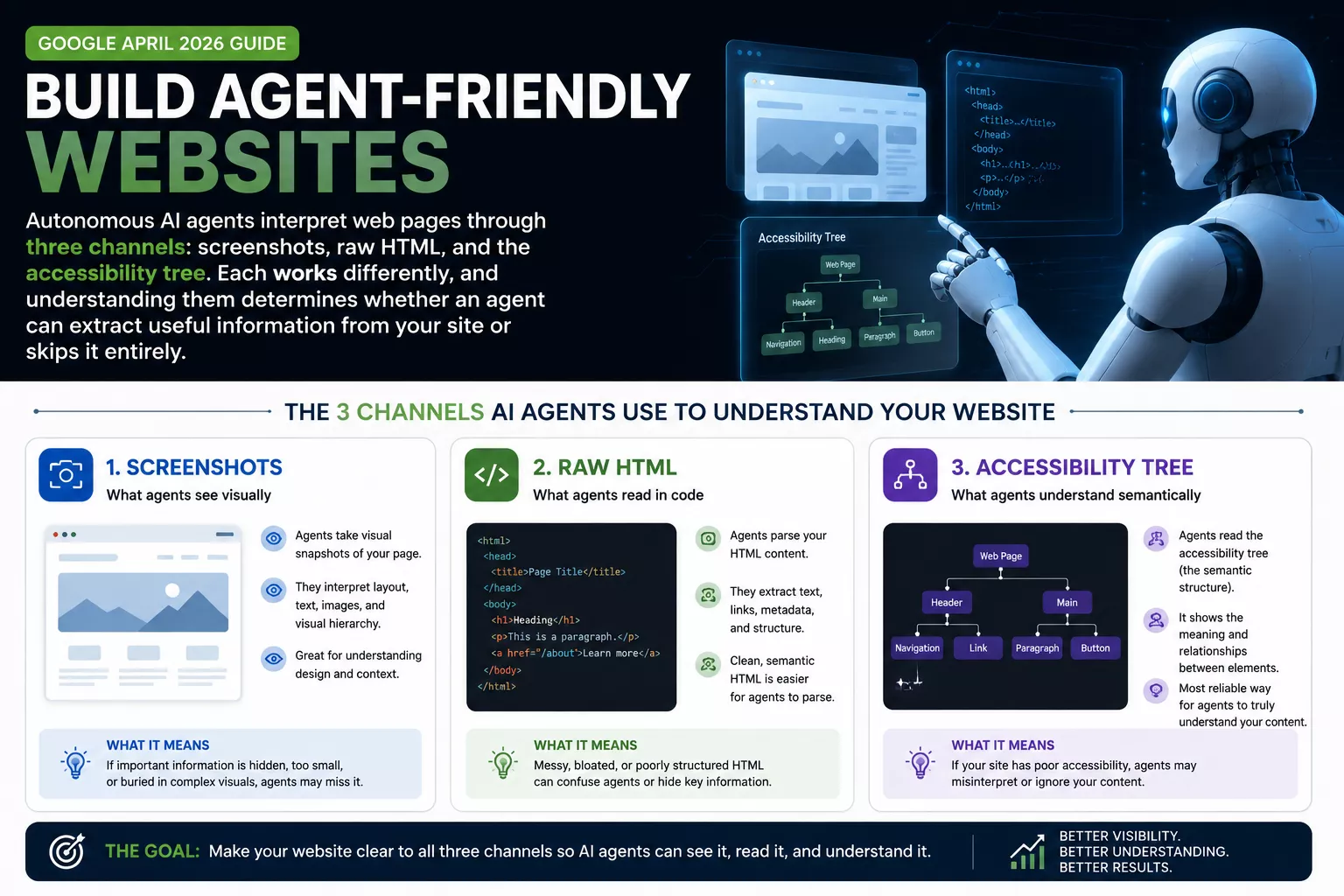
Screenshots let an agent take a visual snapshot and use a vision model to identify elements like forms, buttons, and navigation. It's slow and expensive in tokens, so agents use it as a fallback only when HTML structure is confusing.
Raw HTML / DOM lets the agent read how elements are nested, their hierarchy, attributes, and content. A "Get a Quote" button inside a service container tells the agent that button belongs to that service. Clean, semantic HTML makes this easy.
In my GEO audits of SME websites across India and the UAE, I consistently find that 60–70% of interactive elements contact forms, CTA buttons, nav links lack explicit programmatic names in the accessibility tree. This is the single biggest gap between "human-readable" and "agent-readable" for SME sites.
The practical implication: a visually polished website can be completely invisible to an AI agent if its accessibility tree is weak. You don't need a redesign. You need semantic precision.
What Does Google's Official AI Search Guide Actually Say?
On May 15, 2026, Google released its most explicit guidance yet on AI search optimization, published by John Mueller via the Google Search Central Blog. The guide is now housed under a dedicated "Generative AI fundamentals" section in Search Central documentation.
The headline finding is important: most of what the industry called GEO and AEO is still SEO. The guide confirms that strong technical foundations, original expertise-led content, and earned authority remain the core signals. There are no hidden "AI hacks."
What's genuinely new is the fourth pillar Agentic Experiences. Google explicitly references agent-friendly best practices and emerging standards like Universal Commerce Protocol (UCP) and WebMCP, which enable AI agents to take actions on behalf of users directly from search results.
Crucially, Google also clarified what you can ignore for standard AI search visibility:
- llms.txt files Google Search itself doesn't use them for ranking or AI Overview citations
- Content chunking for machines write for humans; AI extracts naturally from good structure
- Inauthentic brand mentions engineered mentions without real authority don't influence citations
This doesn't mean llms.txt is worthless it matters specifically for agentic browsing use cases (more on that below). But it won't move your AI Overview rankings.
Why Your Rankings No Longer Predict Your AI Visibility
Here's the data point that should reset how you think about search in 2026:
The overlap between top-10 Google rankings and AI Overview citations collapsed from 75% in mid-2025 to just 17–38% by early 2026 (BrightEdge, Mersel AI, 2026). This is the most important structural change in search since the mobile-first index.
What it means: ranking on page one no longer guarantees being the source Google quotes. And with organic CTR dropping 61% when an AI Overview appears (Seer Interactive, 2025), the citation is the prize. Ranking without citation is increasingly traffic-less.
The good news? Brands that do get cited earn 35% more organic clicks and 91% more paid clicks than non-cited peers (ALM Corp, 2026). Citation amplifies what you already have.
In my client work, I find that the SMEs who benefited most from early GEO investment aren't just getting AI traffic they're getting better traffic. AI-referred visitors arrive pre-qualified, already understanding what the business does, with much higher intent to act. The conversion quality shift matters as much as the volume.
The 3 Technical Layers That Make Your Site Agent-Ready
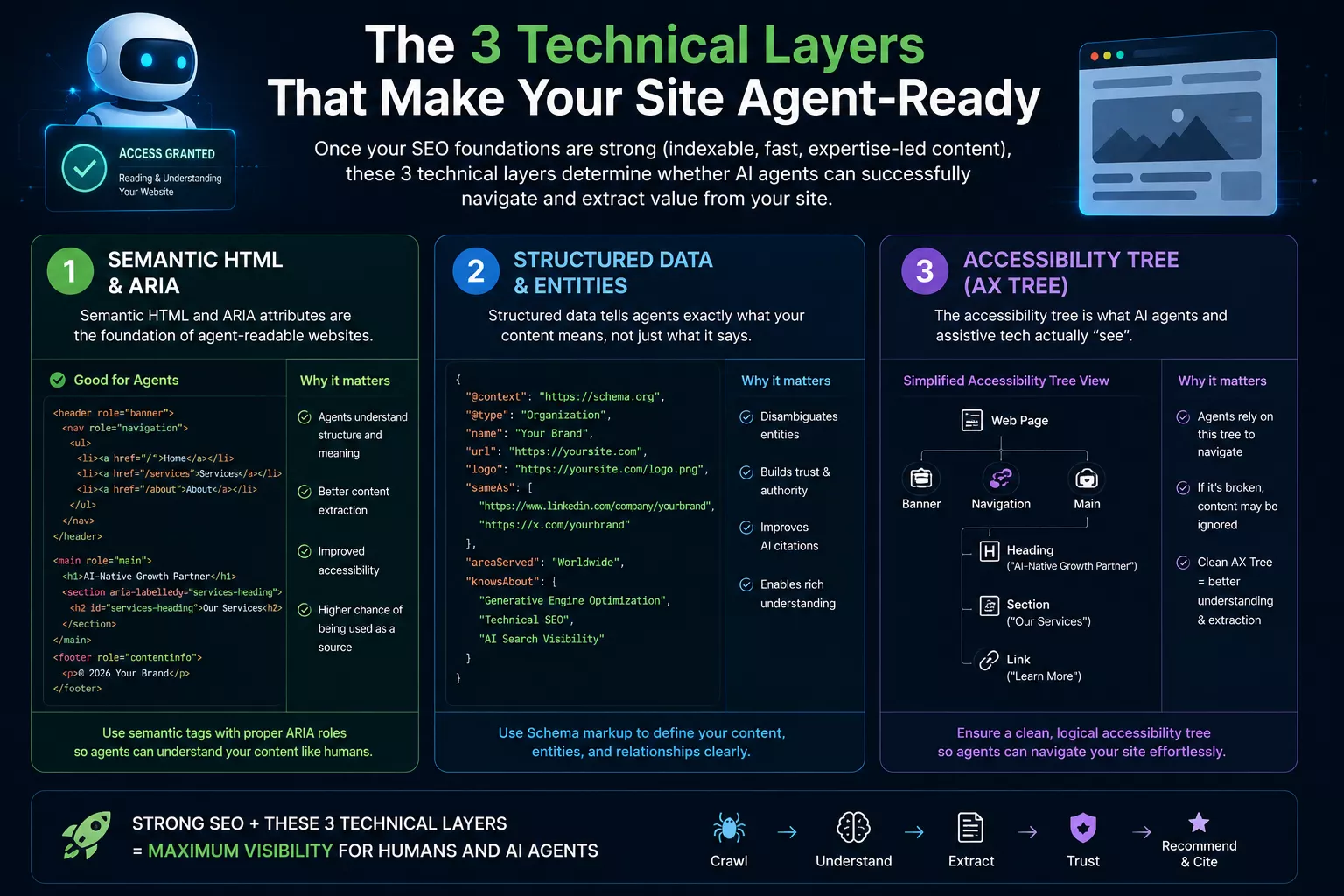
Once your SEO foundations are strong (indexable, fast, expertise-led content), there are three new technical layers that determine whether AI agents can successfully navigate and extract value from your site.
Layer 1: Accessibility Tree Hygiene
Every interactive element on your site needs an explicit, programmatic name that agents can read from the accessibility API. This means:
- Every button needs descriptive text or an aria-label (not just an icon)
- Every form field needs a visible
- Every image link needs alt text that describes the destination, not just the image
- Your navigation landmarks (nav, main, header, footer) must use proper semantic HTML5 elements
Run your site through a screen reader or Chrome's built-in accessibility tree inspector (DevTools → Accessibility tab). If a screen reader can't describe your CTA, neither can an AI agent.
Layer 2: Layout Stability (CLS under 0.1)
Cumulative Layout Shift (CLS) above 0.1 breaks agent DOM navigation. When content shifts after page load banner ads loading, images without dimensions, font swap causing reflow agents pre-calculate interaction coordinates based on the initial render, then click the wrong element when content moves.
Google's new Lighthouse Agentic Browsing audit specifically checks CLS alongside accessibility tree quality. Fix it by:
- Adding explicit width and height attributes to every image and video
- Reserving space for ad slots with CSS min-height
- Using font-display: optional or preloading web fonts to prevent layout shift
Layer 3: WebMCP The Frontier for Transactional Sites
WebMCP is the biggest new standard for 2026. Announced at Google I/O 2026 and now in a Chrome 149 origin trial, WebMCP lets websites expose structured tools JavaScript functions and HTML form actions directly to browser-based AI agents.
Instead of an agent having to parse your DOM and simulate clicks to fill a contact form, you explicitly tell it: here is the "Request a Quote" action, here are the inputs it needs, here is how to trigger it.
Booking.com, Shopify, Instacart, and Intuit have already committed to implement it. If your site has transactional workflows enquiry forms, booking, product selection WebMCP puts you in a fundamentally stronger position than competitors who wait.
For most SME websites, WebMCP is a 2026 priority to plan now and implement when the Chrome Origin Trial broadens. For e-commerce and booking sites, start watching the WebMCP documentation actively.
The GEO Content Strategy That Gets You Cited
The technical layers above make your site navigable for agents. The content strategy below makes it citable by AI Overviews, ChatGPT, Perplexity, and Gemini.
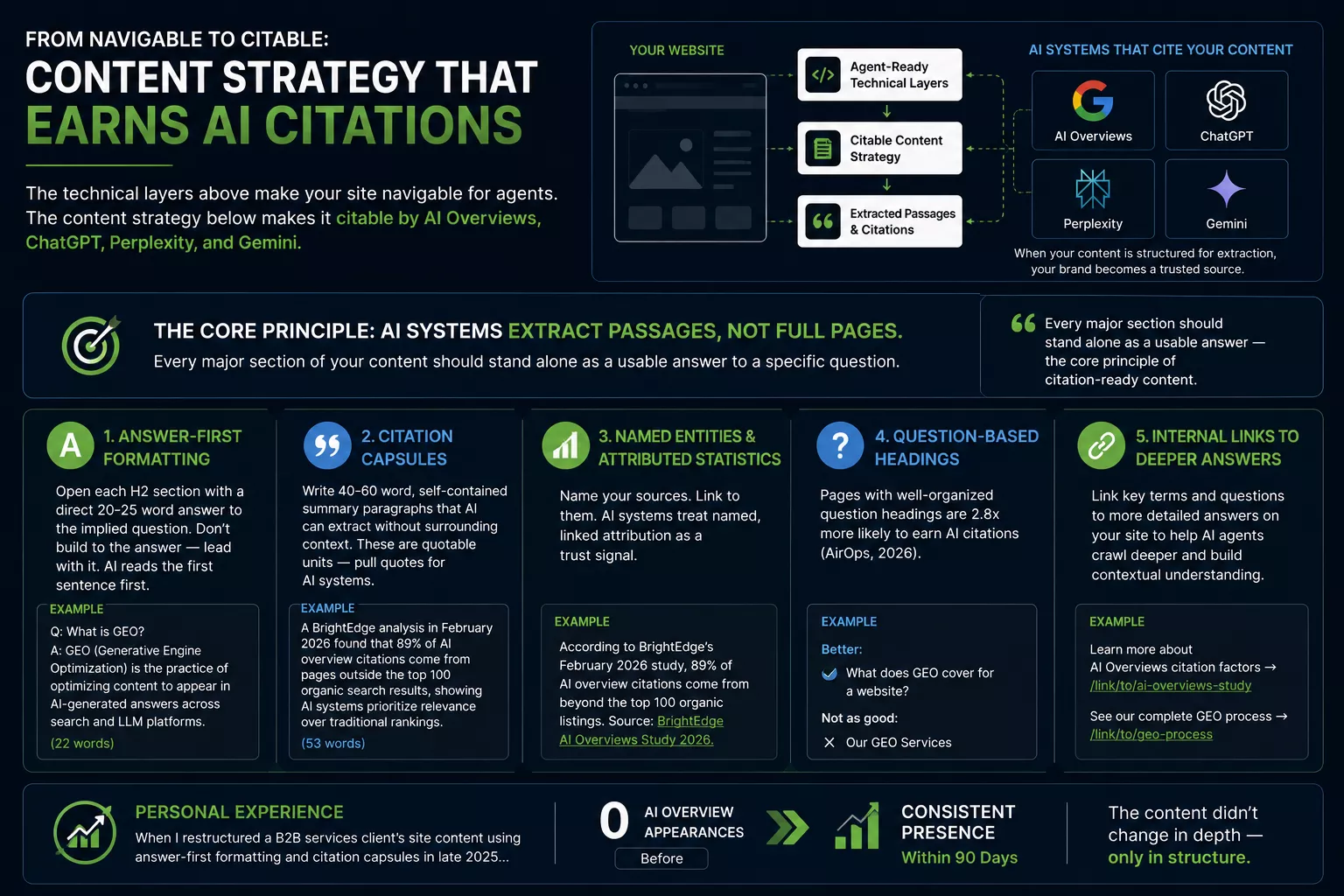
The central principle from Google's guide and every major GEO research study is this: AI systems extract passages, not full pages. Every major section of your content should stand alone as a usable answer to a specific question.
Here's what that means in practice:
Answer-first formatting. Open each H2 section with a direct 20–25 word answer to the implied question of that heading. Don't build to the answer lead with it. The AI system reads the first sentence of each section first.
Citation capsules. Write 40–60 word, self-contained summary paragraphs that a language model can extract without surrounding context. These are quotable units think of them as pull quotes for AI systems.
Named entities and attributed statistics. Claims like "studies show" cannot be cited. Claims like "BrightEdge's February 2026 analysis found 89% of AI citations come from beyond the top 100 organic listings" can be. Name your sources. Link to them. AI systems treat named, linked attribution as a trust signal.
Question-based headings. Pages with well-organized question headings are 2.8x more likely to earn AI citations (AirOps, 2026). "What does GEO cover for a website?" is more citable than "Our GEO Services."
When I restructured a B2B services client's site content using answer-first formatting and citation capsules in late 2025, their AI Overview appearances for target queries grew from zero to consistent presence within 90 days. The content didn't change in depth only in structure.
What About llms.txt Should SMEs Build One?
The short answer: it depends on your audience, not your ambition.
Google's official guide states clearly that llms.txt files are not used by Google Search (including AI Overviews) for ranking or citation purposes. Building one won't boost your AI Overview visibility.
But llms.txt does matter for agentic browsing use cases. As Google explains in its guide, if browser agents Perplexity Comet, ChatGPT Atlas, Chrome's Gemini mode are likely to navigate your site on behalf of users, an llms.txt file at your domain root gives those agents a curated directory of your most important pages and what each does.
About 10% of websites have implemented llms.txt as of mid-2026, but adoption is accelerating fast Anthropic, Stripe, Cloudflare, Vercel, and Perplexity all have one. WordPress (via Yoast) and Webflow have added native support.
Build an llms.txt if:
- You run a service-based business where users might ask an AI agent to "find a consultant who does X" and visit your site
- You have documentation, guides, or resources that benefit from AI indexing
- Your audience is technical or research-oriented
Skip it for now if:
- Your primary goal is Google AI Overview visibility (llms.txt won't help)
- Your site is primarily local services with walk-in or call-based acquisition
The Practical 90-Day Agent-Readiness Roadmap for SMEs
Here's the structured sequence I use with clients to move from "Google-optimized" to "agent-optimized" without disrupting existing rankings.
Days 1–30: Foundation audit and technical fixes
Run your site through Chrome DevTools' Accessibility tab and Lighthouse. Identify every interactive element missing a programmatic name. Fix all form labels. Confirm CLS is under 0.1 using Google's PageSpeed Insights which now includes an experimental Agentic Browsing category in version 150+ (Pragma Code, 2026). Review your robots.txt to ensure you're not blocking AI crawlers: GPTBot (OpenAI), ClaudeBot (Anthropic), PerplexityBot, and Google-Extended.
Days 31–60: Content restructuring for citation
Audit your top 10 traffic pages. Reformat each one with answer-first H2 openers, explicit citation capsules at the end of major sections, and named-entity attribution for all statistics. Convert FAQ sections from accordion-hidden to visible, crawlable text with schema markup. Add FAQ schema (FAQPage in JSON-LD) to service and blog pages.
Days 61–90: GEO measurement setup
Set up a custom channel group in GA4 to capture referrals from chat.openai.com, perplexity.ai, claude.ai, and gemini.google.com. These are your AI referral traffic sources most analytics setups miss them, attributing AI clicks to "direct." Monitor Search Console's new AI performance reports for AI Overview and AI Mode impressions. Track brand mentions across ChatGPT, Perplexity, and Gemini monthly using tools like xSeek or Superlines.
YouTube: Understanding AI Agents and Website Readiness
Frequently Asked Questions
What is Google's Agentic Browsing guide and who does it apply to?
Google's Agentic Browsing guide, published as part of its May 2026 AI optimization documentation, explains how autonomous AI agents navigate websites using screenshots, raw HTML, and the accessibility tree. It applies to any business whose customers might use browser agents (Perplexity Comet, ChatGPT Atlas, Chrome Gemini) to research, compare, or transact on their behalf which in 2026, is virtually every category.
Does optimizing for AI agents hurt my regular SEO?
No it reinforces it. Semantic HTML, clear accessibility attributes, layout stability, and structured content improve both human usability and AI crawlability. According to Google's guide, the same practices that help traditional rankings also support AI agent navigation. The only genuinely new work is the agentic layer: WebMCP, llms.txt for agentic sites, and agent-crawl policies.
How quickly can I see results from GEO optimization?
A Series A fintech startup running a structured GEO program grew AI visibility from 2.4% to 12.9% in 92 days (Mersel AI, 2026). Content restructuring for citation capsules tends to show first results in 60–90 days. Technical fixes like accessibility tree hygiene and CLS improvements can accelerate AI agent accuracy immediately upon deployment.
Should I block AI crawlers in my robots.txt?
Generally no if your goal is AI visibility. Blocking GPTBot, ClaudeBot, or PerplexityBot also blocks the agents that would cite and send traffic to you. Review your robots.txt to confirm you're allowing the crawlers you want. The exception is if you have proprietary content or a paywall where training data concerns outweigh referral value in that case, a selective blocking strategy is reasonable.
What is WebMCP and when should I implement it?
WebMCP is a proposed W3C web standard, now in Chrome 149 origin trial, that lets you expose structured tools (form actions, JavaScript functions) directly to browser-based AI agents. Instead of an agent simulating clicks on your DOM, it reads your explicitly declared tools. It's most valuable for transactional sites: e-commerce, booking, lead generation. Start monitoring the Chrome Origin Trial now if you have transactional workflows early implementation creates a competitive moat.
Citation Capsule: What This Means for Your Business
AI search in 2026 has separated websites into two categories: those that AI agents can read, extract from, and act on and those they quietly skip. The overlap between top-10 Google rankings and AI Overview citations collapsed from 75% to 17–38% in under a year (BrightEdge, 2026). Meanwhile, brands earning AI citations see 35% more organic clicks than those who don't. The infrastructure shift is real, the data is clear, and the window for early-mover advantage is open right now exactly as schema markup was in 2012.
Pradeep O is an AI-Native Business Growth Partner based in Kerala, India, serving SMEs across UAE, India, and global markets. He specializes in Generative Engine Optimization (GEO), AI Overview strategy, and conversion-first digital growth. Work with Pradeep
View GEO & AI Search Projects | Read More on GEO Strategy | Contact Pradeep
GEO, AI Agents, Agentic Browsing, AI Overviews, WebMCP, AI-Native SEO, Generative Engine Optimization, Google AI Search Guide 2026, LLM Citation, AI Search Optimization